
KINGDOM HEARTS: a complete retrospective on a saga created by Disney and Square
by Cristian Mazzini
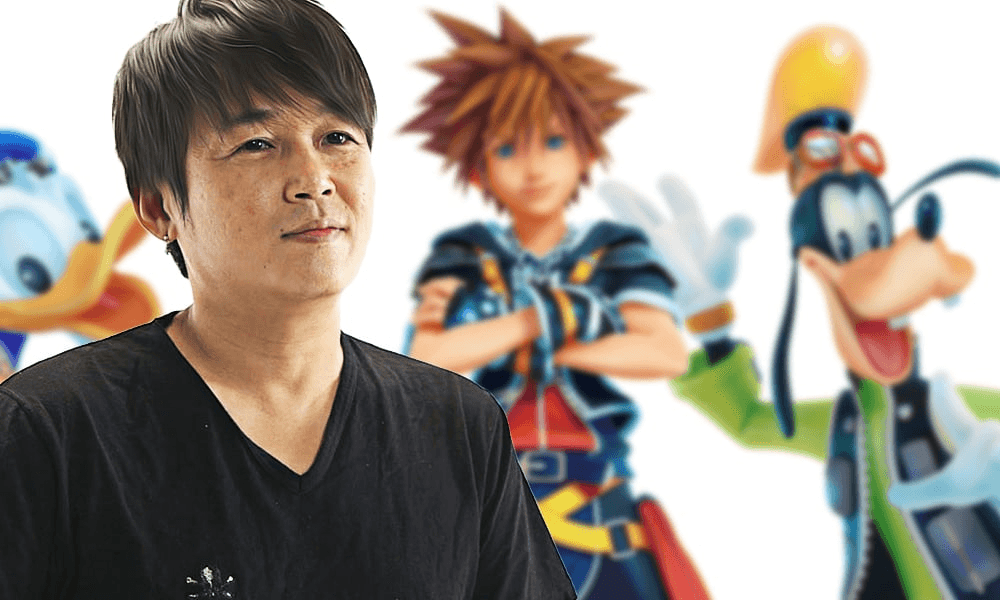
It all began at some unspecified point in the late 1990s, when a very young Tetsuya Nomura was searching for a unique idea that could lead to the creation of HIS own Super Mario 64—a game already hailed at the time as an absolute masterpiece of video game history, as well as the first ever to pioneer the 3D platformer genre.
Nomura explained that the idea stemmed precisely from his desire to create a 3D game in which the player could move freely—something that had made a deep impression on him after playing Super Mario 64.
The Elevator: The Birth of a Crazy Idea
The famous elevator story is indeed true as the starting point of the collaboration, but it has often been simplified in popular accounts.
Square and Disney Japan had offices in the same building, and Shinji Hashimoto had a chance encounter with a Disney executive; from that conversation, the idea of a collaboration was born, and subsequently, Hashimoto and Hironobu Sakaguchi discussed the project with Nomura, who happened to be present and volunteered to take charge of it personally.
This brings us to a crucial point:
Disney wanted to create something featuring Mickey Mouse (then, as now, the face of the company), but Square had different ideas on the matter; they didn’t want to create a run-of-the-mill “Disney game.” Nomura explained that the idea for Kingdom Hearts didn’t originate at that exact moment—he had already been thinking about creating something similar and seized the opportunity to pitch the idea and launch the project.
Kingdom Hearts didn’t simply stem from the idea of “let’s put Disney in a Final Fantasy”; it arose from the desire to create a new, original universe using Disney as a fundamental element.
The Minds Behind the Project
Tetsuya Nomura: The creative heart of the series, as well as the character designer for Final Fantasy VII at the time and later for Kingdom Hearts.
From the very beginning of the series, he has been responsible for character design, narrative philosophy, direct relations with Disney, and the concept of “heart” that has always distinguished this series.
When asked what he wanted to create in Kingdom Hearts, he replied that the theme of connections between people—even when they aren’t physically together—would be fundamental.
Shinji Hashimoto: The producer who played a key role in turning the possibility of a Square-Disney collaboration into a reality.
Hironobu Sakaguchi: The father of Final Fantasy, essential to understanding the creative environment from which Nomura emerged.
Yoko Shimomura: Creator of the game’s iconic and wonderful soundtracks; to talk about Kingdom Hearts without mentioning “Dearly Beloved,” “Destiny Island,” “Roxas’s Theme,” “Traverse Town,” “The Other Promise,” and many others would be a crime.
Shimomura’s music isn’t simply a soundtrack—it’s part of the saga’s emotional identity.
Disney’s Confirmation
The initial goal was actually to keep the story relatively simple to suit Disney’s audience, but Nomura’s vision gradually steered the project toward something much more ambitious (clearly within the limitations imposed by Disney).
Nomura also explained that more than 20 worlds had initially been considered, but this number was reduced during the development process. The selection was based primarily on the popularity of the films, the appeal of the characters, and the potential to transform those settings into something fun to explore.
The ultimate goal was indeed to create a completely new IP that would unite the universe of Final Fantasy and JRPGs with that of Disney’s magical worlds, but above all, it was a massive commercial move to boost both universes—they were supposed to cross-promote each other; That’s why the first game, in particular, has so little original story—because the initial goal was to maximize sales.
Disney approved the project and development began, with the first game released on PlayStation 2 on March 28, 2002, in Japan, and then in Europe on November 15 of the same year.
Sora: The Protagonist Who Wasn’t Supposed to Exist
Sora is the perfect embodiment of what Kingdom Hearts was meant to be.
Not Mickey Mouse, not Donald Duck, not Cloud, not a Final Fantasy character—but rather a completely ordinary yet original boy who combined the “Nomura-esque” style of Final Fantasy with characteristics of classic Disney characters, ultimately leading to the concept of the heart, identity, memory, and connection that gradually became more and more central.
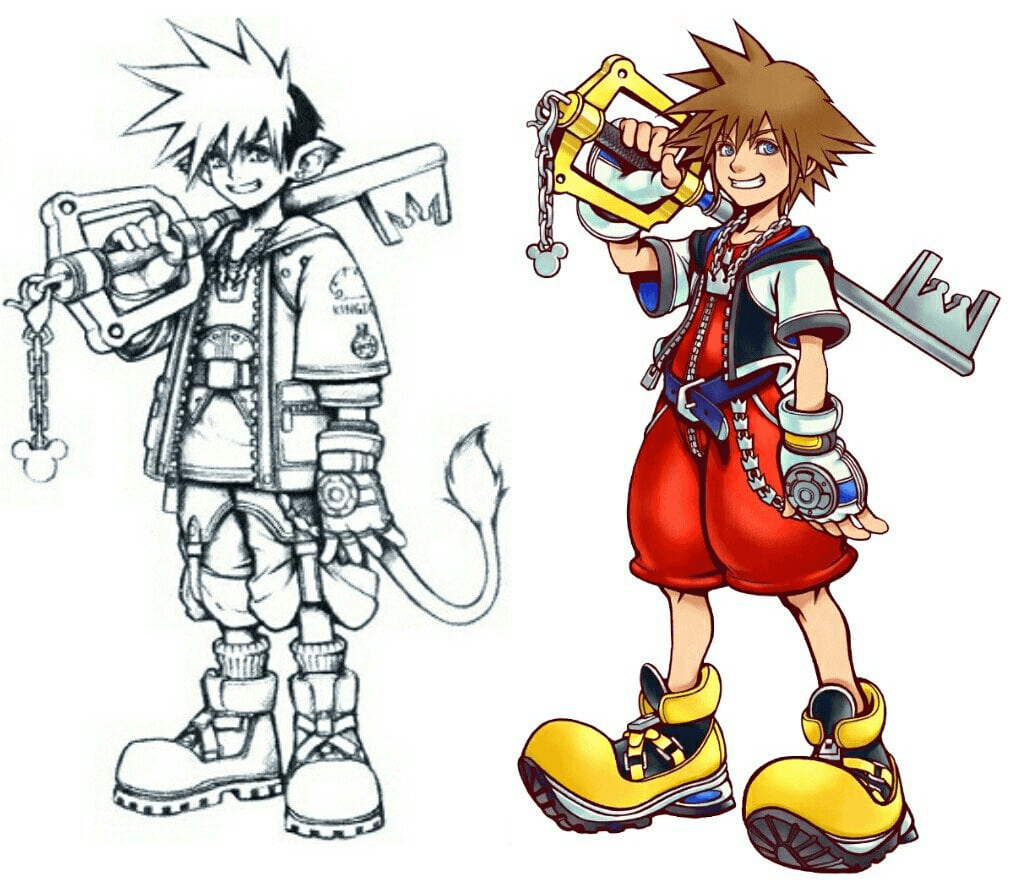
Sora wasn’t initially conceived as we know him today.
He had much more animalistic and non-human features—more precisely, he was an anthropomorphic human-lion hybrid armed with a chainsaw rather than a Keyblade.
This design, so different from the final one, was the result of a series of creative compromises and discussions between Square (now Square Enix) and Disney.
In the early sketches from 1999, Sora’s appearance and equipment featured radically different details: he had feline ears, claws, a lion’s tail, and wielded a chainsaw-sword instead of the famous key; he also wore loose, heavy clothing, boots, and a headpiece.
Why was the design completely changed?
Disney completely rejected the chainsaw, deeming the weapon too violent and out of place for the atmosphere of its worlds; it was therefore redesigned by Nomura, who transformed it into the iconic Royal Chain we love today.
The change to his outfit stemmed from his extreme resemblance to Zidane, the protagonist of Final Fantasy IX; to avoid redundancy, they decided to remove the tail.
Finally, since Disney was very clear that it didn’t want Mickey Mouse to be the main face and protagonist of the game, Nomura’s team decided to pay homage to him by depicting him in his classic outfit: red shorts, giant shoes, and white gloves.
And so, SORA was born.
The Game’s Origins in 2002
As I mentioned earlier, the game was released in 2002. So far, I’ve explained how the project came about; now let’s move on to how they managed to make it work.
The first Kingdom Hearts had something that, on paper, seemed almost impossible:
A world in which Disney and Square didn’t seem like two unrelated elements.
Donald Duck and Goofy could travel alongside Sora.
Cloud could exist in the same universe as Hercules.
Tarzan could meet completely original characters.
And all of this was held together by a brand-new story.
It seemed like an impossible idea, yet it became a legendary saga that still has a massive fanbase today, one that has been waiting for years for the fourth numbered installment.
The game was released in Japan on March 28, 2002, before later arriving in the West.
Its incredible success prompted Square to transform what could have been a one-off experiment into a full-fledged saga, introducing more and more original characters and gradually shifting the focus away from the Final Fantasy characters. Over time, this transformed the series from a simple crossover between two existing worlds into a completely new series with its own narrative arcs and unique characters, leading to the famous “Nomurate” that we all know by now—and that longtime fans have come to both love and hate over time.
From a crossover to one of the most beloved video game sagas
Since then, the game has launched a very long-running saga, spanning more than 10 games—only 3 of which are numbered—with the fourth recently announced for late 2027.
(I’ll dedicate a separate article to Kingdom Hearts 4 because I have a lot to discuss and speculate about.)
KINGDOM HEARTS 2:
Kingdom Hearts 2 fully established the series, transforming it from a mere crossover into a fully credible IP (albeit one riddled with narrative issues) that remains unique and cohesive.
Many (myself included) consider it the pinnacle of the series, from its varied gameplay to the incredible story that began with Chain of Memories and 358/2 Days.
It’s called Kingdom Hearts 2, but it isn’t the second game released. The series has faced some controversy because, to bridge the gap from the first game and later between the second and third, several games were created—essential to the narrative but “side” titles—which, incidentally, were released on different consoles, so you either had to own them all or fall behind in the story.
Fortunately, over the years, the 1.5+2.5 and 2.8 collections were released, containing all the games and easily accessible on a single platform.
KINGDOM HEARTS BIRTH BY SLEEP:
Speaking of unnumbered games, Kingdom Hearts: Birth by Sleep is one of them. In terms of release order, it falls between Kingdom Hearts II and Kingdom Hearts III; chronologically, it takes place 10 years before the events of the first Kingdom Hearts, introducing the Keyblade War and a new trio of protagonists never seen before.
While 358/2 Days and Chain of Memories introduced Roxas and Organization XIII, Birth By Sleep introduced Aqua, Terra, and Ventus, expanding the saga’s mythology.
Here we can begin to explain how Nomura transformed a simple crossover into a massive narrative universe where, to understand all the details, you actually have to play the canceled mobile games—yes, you heard that right. (Maybe I’ll write a dedicated article about it in the future.)
The Big Problem with Kingdom Hearts
This brings us to the saga’s major problem, which I mentioned earlier.
The plot becomes unnecessarily complex; the games were originally released on different platforms and later compiled into collections; there’s a lack of detail due to canceled mobile gacha games; there’s a lack of remakes worthy of the saga—and I could go on… this saga is riddled with problems.
This brings us to the fundamental question: “Is Kingdom Hearts really a series that’s too complicated narratively, or is it a story that needs to be experienced?”
In my opinion, the answer lies somewhere in the middle—it’s a saga that has undoubtedly taken many different turns over time, leaving the community with more questions than answers.
We still don’t know a lot of things, but as a fan of the game, I’m also certain that if you experience it over the years, it will undoubtedly find a place in your heart. Just like with *One Piece*, people continue to speculate and come up with theories about the future—and that’s part of the beauty of it: the journey, the affection we feel for the characters, and the emotions they evoke in us.
Kingdom Hearts III: 17 years later
The first Kingdom Hearts was released in 2002; the third installment (or rather, the tenth, if we count all the titles) came out 17 years later, in January 2019—almost 17 years later.
In the meantime, the series has become something completely different from the original concept.
We owe this long wait to several key factors, such as the announcement being made extremely far in advance of the release, the exact same mistake Square Enix has made in recent years with the fourth installment, announced in early 2022 for the series’ 20th anniversary and re-announced a second time four and a half years later, in June 2026, during a generic and completely unexpected Nintendo Direct coinciding with the 25th anniversary.
Another factor was the switch to the Unreal Engine, which slowed down development.
The fact that it was intended to be the concluding chapter of the Xehanort saga and the Keyblade War certainly didn’t help the game’s release, as it was supposed to answer several questions and raise new ones for the next installment.
Despite the countless problems, they finally pulled it off—the game was released, but…
It created a lot of plot holes and various issues that infuriated fans, who, after years and years of waiting, found themselves with a wonderful, magical world—the hallmark of this IP— but at the same time, a game full of inconsistencies and plot holes hastily patched up, with Disney worlds that—undoubtedly due to pressure from the multibillion-dollar corporation—were practically “copy-and-paste” versions of the original movies (see the world of Frozen).
I want to make it clear that I absolutely love this series; I consider it my all-time favorite because of the emotions it has evoked in me and the impact it has had on me. However, it goes without saying that, since I’m writing a comprehensive retrospective, I need to set aside my personal bias and speak more objectively.
The Music of Yoko Shimomura
I know, I might be repeating myself, but Shimomura’s soundtracks are just so beautiful.
I dare you to tell me you haven’t spent entire minutes mesmerized in the menu listening to “Dearly Beloved” in its various versions—personally, it happens every time I start the game.
That feeling of melancholy that washes over you—it (almost) makes you want to cry…
Yoko’s music is one of the main reasons so many of us have wonderful, indelible memories of this saga, because we associate it with moments in our lives when we were naive and carefree; we link it to the major events the game showed us and the emotions it evoked.

Kingdom Hearts today
Let’s fast-forward to the present.
The Dark Seeker Saga concluded with *Kingdom Hearts III* and its DLC, *Re Mind*, but the story isn’t over yet.
The saga has now entered the Lost Master Arc, with *Kingdom Hearts IV* as the next major chapter.
The 20th-anniversary trailer had already hinted at this transition to a new phase and introduced Quadratum. Square Enix also used the song “Reality in the Dark” for the 20th anniversary, which is associated with the upcoming Kingdom Hearts IV.
To date, we’ve seen two more trailers: the first at the June Nintendo Direct, which gave us a brief look at Quadratum and introduced the “new” characters from the canceled mobile games; and the second (and most interesting) at Disney’s D23 in August, where we were shown the first Disney world and plenty of plot details.
I won’t say anything else because I want to write an article dedicated to speculation about Kingdom Hearts 4, so don’t miss it—I’ll be sharing my in-depth take on everything they’ve shown us.
I hope you enjoyed this retrospective, and if you’d like, check out my other articles.
Thanks for reading this far, and see you next time! ;)